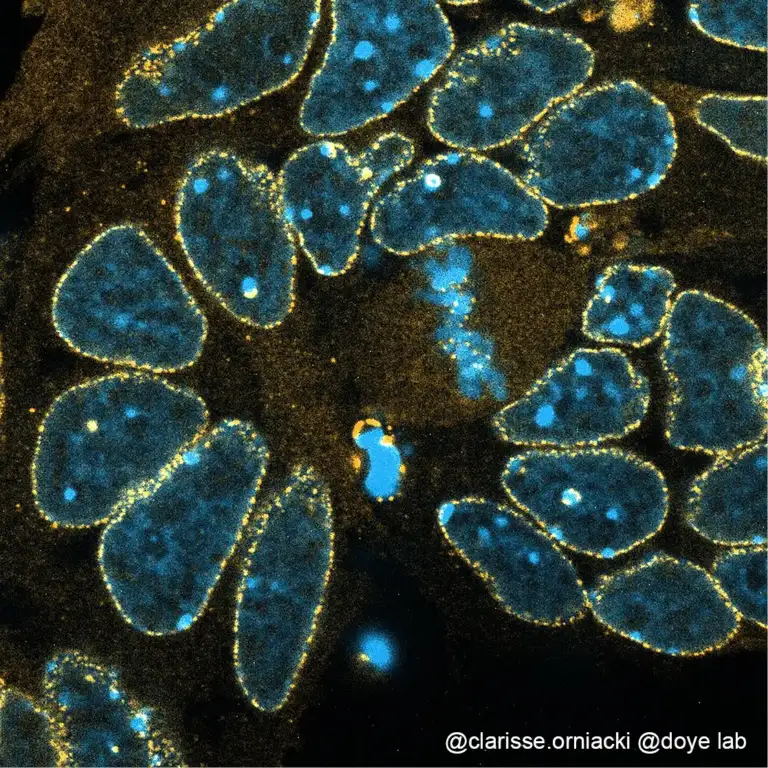
Nuclear Pore Complexes (NPCs) are elaborate structures embedded in the nuclear envelope and composed of multiple copies of about 30 different proteins termed nucleoporins (Nups). Our previous work contributed to the characterization of a major structural sub-complex of NPCs, the Nup107-160 complex (also called “Y-complex“), and to highlight its role in NPC assembly, its contribution to various stages of mitotic progression, and its involvement in embryonic stem cell differentiation.
In recent years, several teams have identified mutations in genes encoding structural Nups, notably Y-complex Nups, in patients with an early-onset and severe kidney disease and/or neurodevelopmental disorders, mainly microcephaly. However, the reason why mutations in these ubiquitously expressed Nups lead to pathologies mainly affecting the kidney and/or the brain remains a mystery.
To mimic the ”disease” condition associated with distinct nucleoporin mutations, we are using human induced pluripotent stem cells (hiPSCs) generated either from peripheral blood cells from patients with NUP mutations (collaboration with C. Antignac , G. Mollet and the iPSCs facility from Imagine Institute, Paris) or from healthy individuals in which mutations are introduced by CRISPR/Cas9-mediated gene editing. To investigate organ- and cell type-specific and thus pathologically relevant phenotypes, the iPSCs are differentiated in 2D towards neuronal progenitors, neurons, or specific kidney cell types (podocytes), or in 3D brain or kidney organoids (with help from the enSCORE plateform).
In both pluripotent cells and their derived organoids, we then study the impact of Y-Nups mutations on NPC assembly, nuclear transport, cell division and migration, and gene regulation.
By elucidating the role of these nucleoporins, our work should contribute to understanding the mechanisms by which mutations or misregulation of these nucleoporins lead to various pathologies.

